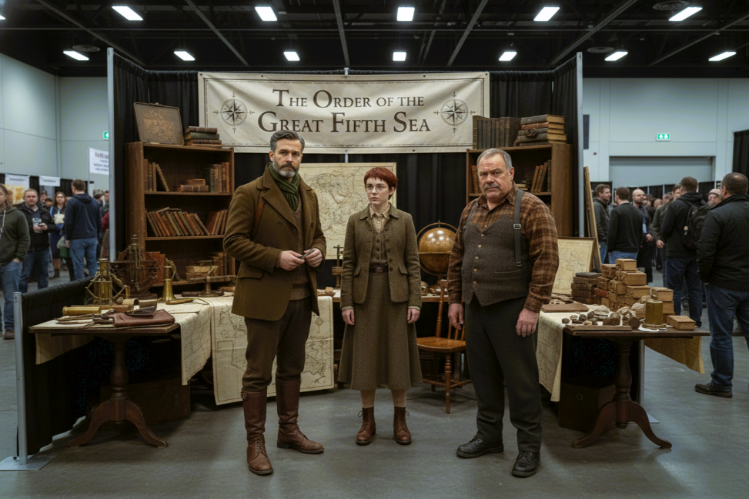

Booth 417: Notes on Public Misunderstanding
Filed by Nora Pettigrew
We agreed to attend the Wisconsin History Conference because, on paper, it seemed reasonable.
This judgment did not survive contact with registration.
The stated objective was modest. We would set up a booth, answer questions, clarify a small number of persistent misunderstandings regarding shoreline history and long-term observation, and then leave quietly at the end of the day with our materials intact. Alistar described this as “participation, not outreach,” which is the phrase the Order uses whenever it wishes to be present without being accessible.
Booth 417 was assigned to us between a railroad ephemera display and a man selling reproduction cannonballs. He described himself as a metallurgist. He repeated this information several times over the course of the morning, as if expecting follow-up questions. We did not provide any.
The Booth
Charts insisted that the ledger be placed flat, centered, and clearly visible while remaining unmistakably non-interactive. Klara adjusted the map twice because one inlet appeared, in her words, “judgmental” under the overhead lighting. Alistar stood several feet back, hands folded, evaluating the table with the expression he usually reserves for language that may later be misquoted.
I taped the title card down. It said exactly what it was meant to say. Several people read it carefully and then looked around for the part where it explained itself further.
Within ten minutes, someone asked how to join.
Alistar explained, with practiced calm, that the Order does not recruit.
This explanation did not close the matter. It appeared to open something.
On Explaining Ourselves Poorly
The most common question was, “So what is this, exactly?”
We answered honestly, which I now understand to have been a tactical error.
Klara spoke about continuity, care, and long horizons. Charts referenced records, custody, and the importance of not moving things once they are placed. Alistar framed the Order as a responsibility rather than an organization, which sounded reasonable until he attempted to say it a second time. I offered, at one point, “We pay attention for a long time,” which I believed to be clear.
People nodded. This nodding had the quality of assent without comprehension, like accepting directions that involve both a footbridge and a seasonal water level.
Someone asked if we were a living history group. Someone else asked if we were affiliated with the state. A third visitor asked if this was “like a club, but private.” One man asked, very quietly, if we were “allowed to say.”
Eventually, the questions stopped. At that point, people began drawing conclusions independently.
The Clothing Situation (Revised for Accuracy)
It took longer than it should have to recognize that our clothing was doing more explanatory work than our words.
We were dressed as we usually are for field travel and formal observation: heavy tweed jackets, layered wool, sensible boots, brass fastenings, and the general air of people who expect wind, weather, and extended silence. The look leans academic by way of early expedition, Edwardian in cut if not in calendar, and entirely practical if one anticipates cold stone floors or an unheated archive.
Alistar’s coat suggested a man who might have opinions about latitude. Klara’s scarf implied both scholarship and readiness. Charts’ pin, which he insists is functional, caught the light often enough to invite speculation. My own jacket, which has seen three shorelines and one ferry incident, was described by a woman as “very committed,” a term I have not yet resolved.
Someone asked whether the attire was period accurate.
Klara said, “It’s field appropriate.”
This response was written down.
Photography Begins
The first request for a photograph surprised us.
It was polite. A woman asked if she could take a picture “with the group.” Alistar paused for just long enough that consent was inferred. The photo was taken.
Then another. Then several more.
A group of four arrived already arranged, instructing us where to stand. Someone suggested we not smile “to keep it authentic.” A teenager asked what level we were on. Another asked whether leveling was mandatory or optional.
Charts stared at the ledger as if it might intervene on procedural grounds. It did not.
We did not refuse. We also did not understand what we had agreed to. People posed beside the banner. Someone asked if we could “hold the expedition posture” for a moment. Another thanked us for “not breaking character.”
We were not aware we had entered one.
Popularity, Incorrectly Applied
By midday, a conference volunteer informed us that we were one of the most photographed booths in the hall.
This information was delivered as praise.
She asked whether we wanted a scheduled photo window to manage demand. Alistar declined. Klara asked whether declining was permitted. It was, though the volunteer looked faintly disappointed, as if we were refusing a compliment on principle.
Someone else suggested a panel on “alternative approaches to history.” We declined again. At this point, the pattern of refusal began to resemble intention.
Meanwhile, letters began appearing on the table.
They were handwritten. Careful. One included a résumé. Another referenced “alignment with values.” A third contained only the sentence, “I get it,” which I do not believe was true.
Charts created a folder labeled UNSOLICITED MATERIALS and placed it beneath the table without opening it. Later, he added a subfolder. Interest increased measurably after this.
Membership Questions
The second most common question concerned how one becomes a member.
We explained that membership is private.
This caused visible distress in several individuals.
Multiple people asked how any of us had joined. Alistar began an answer and stopped. Charts said, “That’s not a single event.” Klara nodded in a way that suggested agreement, finality, and the closure of discussion.
I said, “It’s not something you apply for.”
This sentence was later repeated back to me as if it were guidance.
End of Day
We packed up quietly.
The booth showed signs of use. Fingerprints on the map. The title card bent at one corner. The ledger remained intact, though it now contained a single non-member signature. Charts noticed immediately. He stared at it for a long time and then closed the book without comment.
As we were leaving, a man stopped me to say thank you.
He said he did not understand all of it. He said it felt careful. He said it was nice not to be sold to.
This remains the most accurate interpretation of the day.
Closing Note
We did not attend the conference to be photographed. We did not attend to attract interest. We attended to answer questions honestly and to exist, briefly, in public.
What people saw was something else entirely.
This discrepancy should be recorded. Preferably in more than one archive.
— Nora